
Since Russia’s invasion of Ukraine in February 2022, the energy sector has been a critical battleground. The targeted attacks on Ukraine’s energy infrastructure, aimed at weakening the country’s resilience, have severely impacted Ukraine’s energy supply and overall security.
In response to the extensive damages, Ukraine has stepped up the imports of critical energy equipment and fuels to maintain energy supply and to restore its damaged energy infrastructure.

Despite the ongoing war, Ukraine is actively pursuing recovery, economic stability, and a green transition. Biomethane production and export can play a pivotal role in these efforts, offering a sustainable energy source for both domestic use and the European Union.

Green hydrogen will play a central role in global energy transition. On behalf of GIZ, we have analysed hydrogen strategies of various European countries.

Ukraine has huge untapped potential for solar power. A new BE study, commissioned by Greenpeace, highlights the opportunities and barriers to expansion.

This week has been all about Ukraine. On Tuesday and Wednesday, the highly acclaimed Ukraine Recovery Conference took place in Berlin, where we had the opportunity to attend. In addition to the panels, there were many opportunities for interesting background discussions with other participants. There were also numerous side events where key issues were discussed in more detail.
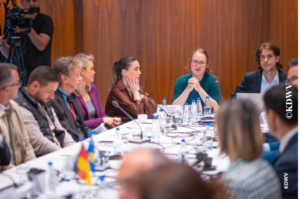
On May 16, 2024, the German-Kosovar Business Association (KDWV) and the German Economic Team (GET) successfully hosted an event at Klan Arena in Pristina, focusing on improving Kosovo’s business climate. The event brought together key stakeholders to discuss the progress and future steps to enhance the business environment in Kosovo.

On the 2nd and 3rd of May 2024, the Tashkent International Investment Forum (TIIF) took place, featuring a keynote opening by Uzbekistan’s President, Shavkat Mirziyoyev. As part of the German Economic Team project, Berlin Economics participated in a high-ranking panel discussion on Uzbekistan’s green transition.

Together with Ecoation, we have organised the conference “Energy-efficient reconstruction of Ukrainian cities” on March 7th, where we also presented our joint study on the topic.
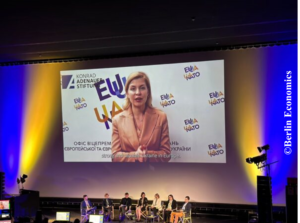
On February 19th, 2024 Café Kyiv, organised by the Konrad Adenauer Foundation, took place in Berlin. Berlin Economics organised three panels for the event.

Together with DLG International, Berlin Economics implements the German-Moldovan Agricultural Policy Dialogue (APD).
 Economic Consultancy